

When ACC launched the Theory of Change strategic plan, the goal was never to wait years for perfect solutions before improving the student experience. Instead, we’ve focused on making intentional, meaningful changes across the institution while continuing to learn, adapt, and build toward larger transformation.
Two years into this work, the impact is already visible.
Across multiple portfolios and initiatives, the Theory of Change is helping expand access to college, strengthen student support systems, improve employee practices, and create more equitable pathways for student success. While much of the work is still ongoing, the results emerging from foundational initiatives demonstrate the power of coordinated, student-centered change.
Expanding Access Through Free Tuition
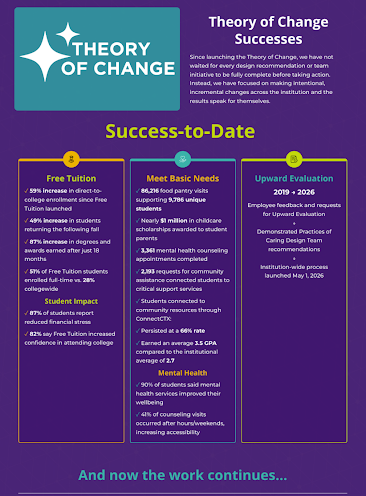
One of the clearest examples of impact has been ACC’s Free Tuition initiative. Since launching, the college has seen a 59% increase in direct-to-college enrollment, helping more students begin their higher education journey at ACC.
The impact extends beyond access alone. Students participating in Free Tuition programs are persisting and completing at significantly higher rates:
- 49% increase in students returning the following fall
- 87% increase in degrees and awards earned after just 18 months
- 51% of Free Tuition students enrolled full-time compared to 28% collegewide
Students themselves are also reporting meaningful personal impact:
- 87% report reduced financial stress
- 82% say Free Tuition increased their confidence in attending college
Together, these outcomes illustrate how reducing financial barriers can influence not only enrollment, but also persistence, confidence, and long-term student success.
Meeting Students’ Basic Needs
Another major area of progress has been the Meet Basic Needs portfolio, which focuses on supporting students beyond the classroom by addressing food insecurity, childcare access, mental health, and connection to community resources.
To date:
- ACC food pantries have supported 9,786 unique students through more than 86,000 visits
- Nearly $1 million in childcare scholarships has been awarded to student parents
- Students have completed 3,361 mental health counseling appointments
- More than 2,100 requests for community assistance have connected students to critical support services
Programs connecting students with community resources are also showing strong academic outcomes. Students connected through ConnectCTX persisted at a 66% rate and earned an average GPA of 3.5, compared to the institutional average of 2.7.
Mental health support has also become an increasingly important area of institutional focus. Among students utilizing counseling services:
- 90% reported that mental health services improved their well-being
- 41% of counseling visits occurred after hours or on weekends, increasing accessibility for students balancing work, caregiving, and coursework
These efforts reflect a growing recognition that student success depends not only on academics, but also on whether students have the stability and support needed to fully participate in college life.
Creating Institutional Change
The Theory of Change is also influencing how ACC approaches employee feedback, organizational culture, and institutional practices.
One example is the newly launched Upward Evaluation process, which emerged from years of employee feedback and recommendations developed by the Demonstrated Practices of Caring Design Team. That institution-wide process officially launched on May 1, 2026.
This progression reflects one of the central goals of the Theory of Change initiative: creating structures that allow employee insights, student experiences, and collaborative design work to shape institutional decision-making over time.
The Work Continues
While these outcomes are encouraging, they represent only part of a much larger institutional transformation still underway. Across ACC, design teams, implementation teams, faculty, staff, and administrators continue working to move recommendations into practice and strengthen the systems that support students every day.
The Theory of Change was designed as a long-term commitment to continuous improvement, collaboration, and student-centered innovation. Nearly two years in, the work is already making a measurable difference and the momentum continues to grow.
The full graphic can be viewed here: https://drive.google.com/file/d/1q-WtQUYy7epVmTOIUtGzGHFm-3xMS2P3/view?usp=sharing
Back to Top