
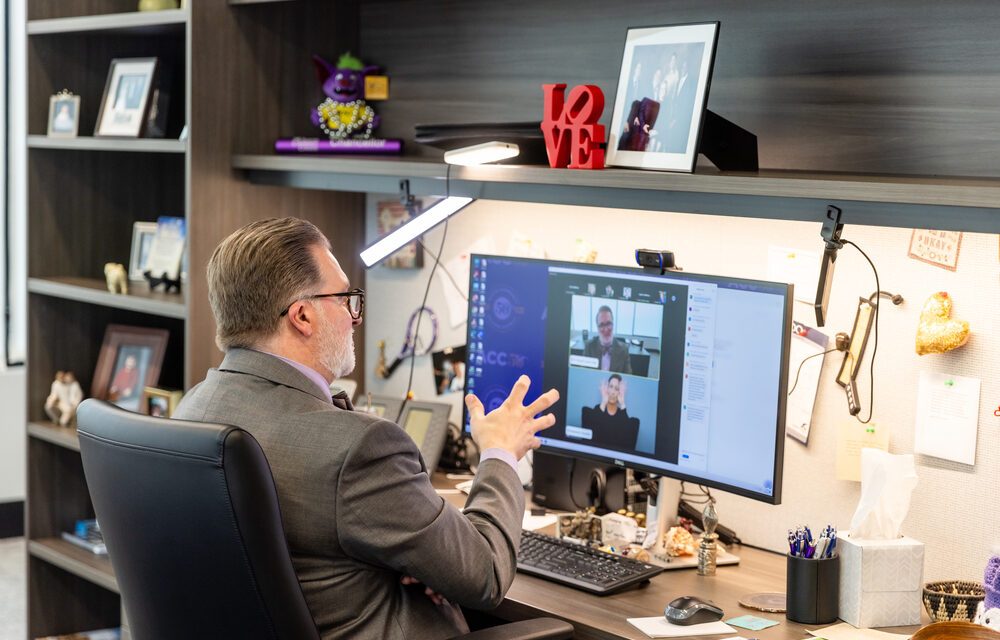
Austin Community College District (ACC) faculty and staff gathered virtually on Friday, August 14, for the last Virtual Employee Town Hall of the summer.
Chancellor Dr. Russell Lowery-Hart opened the Town Hall by reflecting on the influence of his leadership mentor, Barbara Petty. He invited employees to share the names of their own mentors in the chat, emphasizing that real leadership is built on relational capital, trust, and a commitment to students rather than titles or control.
Following his opening remarks, Russell shared other insights and updates at the College. Below is a breakdown of the key takeaways.
The Shift to College 3.0
ACC is shifting to a College 3.0 model — part of a strategic framework developed by Aspen Institute that pushes community colleges beyond access and completion toward long-term labor market outcomes that lead to a family-sustaining wage. Russell walked employees through ACC’s evolution:
- College 1.0 (Access): Focused purely on enrollment and removing barriers.
- College 2.0 (Completion): Focused on what happens when students are here (i.e., retention, completion, and learning outcomes). ACC started transitioning to this model about 15 years ago.
- College 3.0 (Post-College Outcomes): Focuses on ensuring that credentials, degrees, and transfer pathways lead directly to family-sustaining wages within 3 to 5 years.
As ACC continues to perfect College 2.0, we are starting to transition to the College 3.0 model. The 2.0 platform will allow us to build systems and hold ourselves accountable to a 3.0 outcome model.
This new framework has implications for every part of the College — from advising, orientations, career centers, service-learning experiences, and internships to program reviews and even our employer advisory committees — and we will need to show the labor market outcomes of our programs.
To help us track students more intentionally, ACC has been selected as one of only five colleges in Texas granted access to detailed wage data from the Texas Workforce Commission, enabling the district to track student outcomes 3, 5, and 10 years after graduation.
Fall Enrollment Update
Overall, enrollment is up at the College. While new student enrollment is flat, more students are persisting. ACC is projected to exceed 44,000 students by census date, driven heavily by an 8% increase in continuing students. With a new cohort of nearly 5,000 Free Tuition students, the Free Tuition Pilot Program exceeds 13,000 students.
General Assembly Preview
General Assembly 2026 is scheduled for Friday, September 25, from 8:30 a.m. to 3:30 p.m. at Highland Campus (HLC). The theme is “Reimagining ACC: Building for What’s Next.” The event will focus on the Institutional Effectiveness Report Card, the Theory of Change, and AI integration, with a resource fair and food provided. To encourage camaraderie, leadership emphasized in-person attendance and a readiness to participate. To register for General Assembly, click here.
Telework Policy Update
The state passed a law dictating the end to almost all telework approaches in state agencies and higher education. After a year of working with the administrative rule and associated guidelines and procedures, the College’s Telework Policy is moving into implementation. Supervisor training webinars for the updated telework guidelines are happening now. Full implementation of updated telework plans will take effect immediately following the Labor Day holiday, maintaining a student-first approach to ensure operational coverage.
Space Utilization & Highland Business Center Update
Russell shared that the College now has data from a 2-year space utilization study, which shows that we can be more efficient with the space we have.
The College also determined that the Highland Business Center (HBC), also known as HLC 8000, is an unsustainable building. It is estimated that it would cost $20 million to make it habitable long-term.
Based on that data, the College will roll out a plan to transition all operations out of HBC in the next two years. HBC will eventually transition into a revenue-generating asset.
Russell expects to present a complete Campus Purpose and Facilities Plan to the Board of Trustees in late September, which he will share with employees in the subsequent Town Hall.
Design Team Spotlight: Co-Requisite Recommendations
The Co-Requisite (Co-Req) Design Team presented its final recommendations aimed at accelerating developmental math and integrated reading/writing courses paired with college-level credit courses.
Some of their recommendations include:
- Automated & Centralized Placement: Create a central Co-Requisite Office and train specialized staff across departments to automate and streamline TSI placement, replacing slow manual processes.
- Faculty Support: Expand communities of practice, professional development compensation, optional course shells, and grow single-instructor or co-teaching models.
- Wraparound Student Supports: Introduce a tiered support approach and expanded cohort models to assist students facing external life challenges.
- Expanded Offerings & Frameworks: Increase weekend/evening sections and implement strong-start 8-week course pairings similar to the Capital Idea pilot model.
- Holistic & Multiple Measures Placement: Move beyond relying solely on TSI scores by incorporating high school GPAs, transcripts, and holistic intake forms.
View their full list of recommendations on the Theory of Change website.
The design phase of the Theory of Change is nearing completion, with only three teams left to transition to implementation this fall.
Watch the Full Recording: To view the full presentation slides or rewatch the town hall recording, visit the ACC Town Hall webpage.