

On July 6, 2026, the Austin Community College District (ACC) Board of Trustees unanimously approved a $583 million balanced operating budget for fiscal year 2027 (FY27). While news of a balanced budget is always welcome, this year’s budget cycle tells a unique story.
For the first time since the 2008 Great Recession, ACC navigated declining property values, changes in state performance funding, and rising operational costs. Yet, despite $10 million in initial budget pressures, the College was able to maintain tuition rates for the 13th consecutive year, preserve its $23-an-hour minimum wage, and deliver a creative yet competitive employee compensation package.
While the College is facing challenges, its financial situation is night and day from when ACC Executive Vice Chancellor of Finance & Administration Neil Vickers took on managing the budget in 2002.
Here is a closer look at how we got here, why people remained the top priority, how this year differed from the past, how the College balanced the budget without cutting core operations, and how ACC is preparing for future financial challenges.
ACC’s Budget Evolution
When Vickers took over the budget 25 years ago, the College had a deficit, under one month of reserves, and it was refinancing debt.
“We weren’t always viewed as a major powerhouse. We changed ACC’s position in the community through sound financial planning,” he said.
Vickers credits the support of the Board of Trustees for allowing the College to maintain a steady and consistent financial philosophy for the past two decades. Even when the COVID pandemic spiked property taxes, the College remained fiscally conservative and built up its reserves knowing that the additional revenue wouldn’t last forever.
Investing in People
ACC’s biggest expense is compensation and benefits, and it is getting harder to solve. In a tight fiscal year, standard financial logic might suggest freezing raises.
However, College leadership and the Board of Trustees made employee compensation a top imperative, as they have for decades. In the last 30-plus years, there was only one year the College didn’t give a raise.
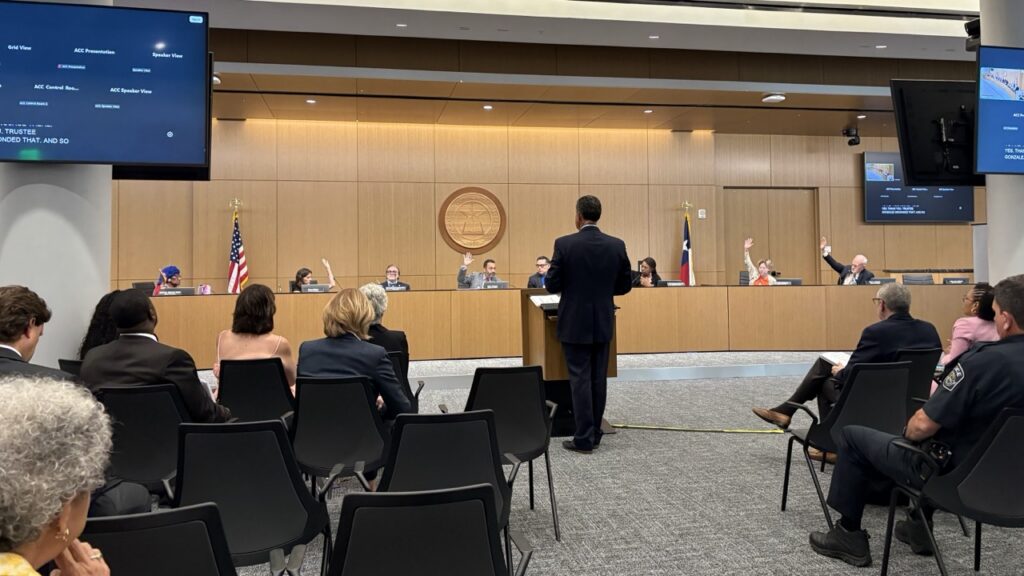
Following feedback from trustees and employee associations, administrators crafted a balanced compensation package combining ongoing base salary growth with immediate cash relief. In addition to a 2% raise, eligible employees will receive a one-time, lump-sum payment — paid out of a surplus from this year’s budget — on August 31, 2026.
Read more about the approved compensation structure here.
Why FY27 Was Different
ACC has experienced annual growth in local property tax revenues for more than a decade. That property tax revenue consistently funded annual compensation increases, college expansion, and new initiatives.
This year, that dynamic shifted:
- Property tax revenues leveled off: For the first time since 2010, regional property values declined, resulting in flat overall property tax revenue.
- State performance funding (HB 8) constraints: While ACC demonstrated strong student outcomes, state performance funding under HB 8 operated out of a capped statewide pool, limiting additional revenue allocations.
- Fixed cost inflation: Rising inflation and a 7.5% increase in Employee Retirement System (ERS) health insurance premiums added an unexpected $2.5 million expense to the budget.
- Rising demand and enrollment: Demand for services and student support continues to grow, requiring sustained operational capacity.
Together with the College’s starting proposal to provide a 3% baseline salary raise, these factors created an initial $10 million budget gap.
That amount was reduced to $7 million when the compensation package was restructured.
Closing the Gap
Unlike many institutions that respond to financial strain with across-the-board cuts, hiring freezes, or layoffs, ACC finance leaders, led by Vickers and Deputy CFO Carlos Martinez, conducted a surgical review to identify internal savings.
To close the $7 million funding gap and balance the FY27 budget, the College used a combination of cost reductions, structural adjustments, and targeted reallocation:
- Eliminating long-standing vacancies: Reviewing vacant positions open prior to 2025 and closing 50 unneeded roles reduced ongoing salary obligations by $3 million, creating recurring savings without impacting filled roles.
- Reduction to hourly funding: A $2 million reduction in the overall hourly labor budget aligned temporary staffing levels with actual workload needs.
- Reduction to technology and capital outlay: The College is saving $2 million by consolidating its software portfolio and identifying underutilized computers in order to reduce the cost of the College’s multi-million dollar computer replacement budget.
Preparing for Future Financial Challenges
ACC’s conservative budgeting strategy has positioned the District for long-term resilience. However, Vickers cautions that we should remain vigilant as there may still be some rough patches.
“If we are proactive, we can mitigate that pain down the road,” he said. “While we’ve been good fiscal stewards, there are ways to be more efficient and effective and hold ourselves more accountable.”
The College will spend this next year doing deeper dives into the budget, searching for additional opportunities for savings.
“If things get better real quick, there is no harm, and we can take better advantage of the revenues that come in. Alternatively, if things don’t get better and we need to take action in response, like increasing tuition, we want to make sure we looked at all other opportunities,” said Vickers.
Vickers was named a finalist for the Austin Business Journal’s 2026 Best CFO Awards for his leadership in helping ACC expand access, maintain affordable tuition, invest in workforce training, and deliver on major initiatives that strengthen opportunities for students and the Central Texas community.