
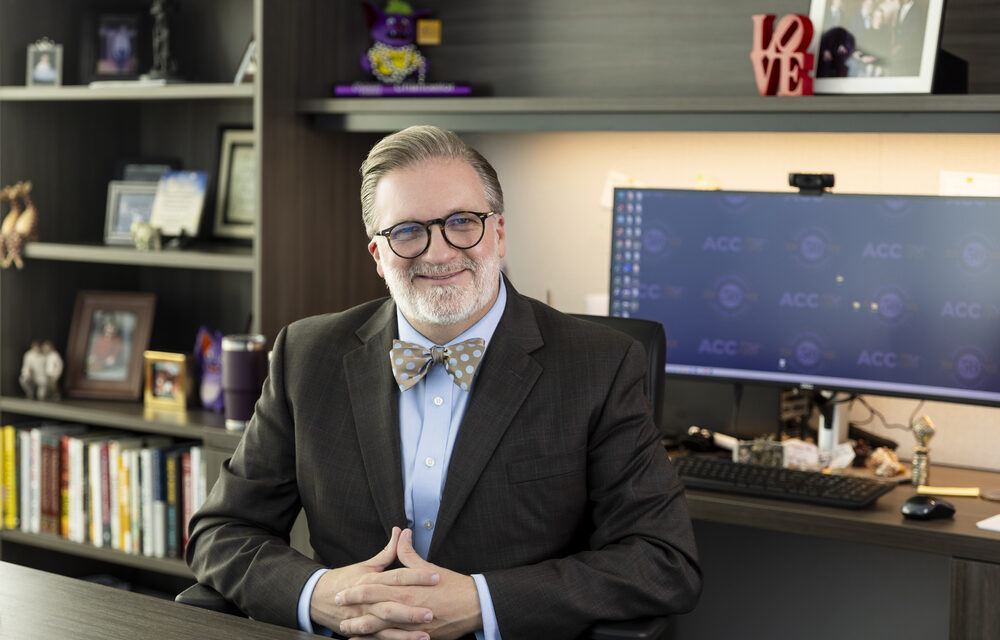
Austin Community College District (ACC) Chancellor Dr. Russell Lowery-Hart helped open the Chronicle Festival 2025 on Tuesday, September 16, joining a national leadership panel on “What It Takes to Support Students Now” He was joined by Dr. DeRionne P. Pollard, president of the American Association of Community Colleges, with Jasper Smith, staff reporter for The Chronicle of Higher Education, serving as moderator.
“To change performance gaps, you have to change the systems that created them. Historically, what we have done is use disaggregated data to train the students how to navigate colleges. That is the wrong approach. Our job is to use the disaggregated data to know how we need to change and adapt to our students. There are some core things that we know help performance gaps across the board, which ACC is tackling through our Theory of Change,” said Lowery-Hart.
The session brought together higher education leaders to examine how colleges can better serve students amid the unique challenges they face today. As one of only two higher education leaders featured in the festival’s opening panel, Lowery-Hart spotlighted ACC’s role in supporting both traditional and adult learners and the importance of community colleges in shaping the future of higher education.
Shifting the Definition of Success
Lowery-Hart emphasized that student success today must go beyond enrollment and graduation:
“Now we are defining success as completing with a degree or certificate that leads to a family-sustaining wage. Community college students are the hope of this country. They are smart, ambitious, and capable, but their challenges are different, and our systems must adapt.”
Building Systems, Not One-Off Solutions
Both leaders called for systemic change in how institutions support students, urging colleges to replace “episodic” responses with sustainable systems grounded in data and student voices.
“We have to redesign the system for and with all students. That doesn’t mean you’re ignoring what past students bring to the conversation, it means you’re building systems for the masses, like required advising, basic needs, tutoring. The way we execute those allows you to see the individuality of your students and acknowledge the different journeys that brought them here,” said Lowery-Hart.
“Students want to be seen, and to be seen means we have to bring them to the table to help make decisions within our institution. We have to listen when they say things that make us uncomfortable and not dismiss them. Colleges have to be much more thoughtful and willing to challenge our own discomfort around students’ needs,” said Pollard.
Scaling What Works with Equity in Mind
Lowery-Hart pointed to advising, tutoring, accelerated courses, and basic needs support as proven practices that must be expanded equitably.
“The core things they need from us: they’re working part-time, but they can’t take seven years to get an associate degree and transfer. They need accelerated eight-week classes. They’re working two part-time jobs while living in the warzone of poverty, and they need help with emergency aid, child care, transportation, housing, and food, which is an epidemic in higher education. They need tutoring support integrated in the class, and classes offered beyond the 9-to-5 window. Our students have told us that directly and have been a part of the Theory of Change that is redesigning Austin Community College.”
Looking Ahead
The conversation also touched on faculty development, the role of technology like AI, and the importance of designing colleges around today’s students rather than outdated models.
Pollard urged higher education leaders to move forward with urgency:
“We have to stop talking about what it looks like and get busy doing the work. At the end of the day, students want to be seen, heard, and valued. We need leaders to do the hard work that Russell is doing on campus right now. We need our student voices not to get lost in the cacophony of folks who think they know who our students are and tell them what their experience should be. We have to learn how to listen.”
Lowery-Hart closed with a call for unity.
“At a moment where our country seems so divided, community colleges can be unifiers. We can love our communities together by loving our students to success. When we double down on who our students are and what the economy needs from them, we can do this— we just have to do it more boldly, more strategically, and with more unity.”
The Chronicle Festival annually draws 3,000–5,000 higher education professionals nationwide. Chancellor Lowery-Hart’s participation positioned ACC on the national stage as a thought leader in advancing student success and equity in higher education.