
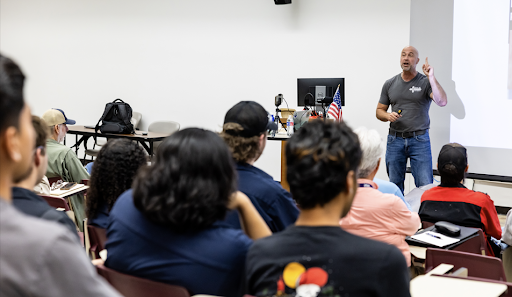
For many men, asking for help can feel like admitting weakness. Mental health advocate Bill McCamley wants to change that.
Tall, broad-shouldered, and muscular, McCamley looks like an imposing figure. He’s also outspoken, unapologetically unfiltered, and believes in speaking to men in a language that resonates with them. His approach is direct, sometimes provocative, and deliberately challenges traditional ideas about masculinity. He now runs the Texas Building Trades Health Foundation, an alliance of trade unions including pipefitters, electricians, painters, and laborers. The Foundation is tackling the problem of death by suicide and overdose head-on as trades workers lead the nation in both categories.
“I see a f**king therapist. More guys should.”
For McCamley, those words aren’t simply meant to provoke a reaction. They’re a challenge to the idea that seeking mental health support is a sign of weakness.
It’s a message he recently brought to Austin Community College District (ACC), where he spoke with students, faculty, and staff about men’s mental health, suicide prevention, and the pressure facing men working in skilled trades and applied technologies.
A former New Mexico secretary of Workforce Solutions, McCamley experienced serious mental health struggles while overseeing the state’s unemployment system during the COVID-19 pandemic. After reaching a breaking point in 2020, he began using his experience to challenge traditional expectations of masculinity and encourage more men to seek support. We sat down with him to learn more about his mental health journey and to get his take on why it’s so difficult for men to ask for help.
What inspired you to become an advocate for men’s mental health, especially among men in the skilled trades?
It started while I was writing my book. I was talking with someone I knew from my political days in New Mexico who works with the building trades unions. He mentioned that two of his apprentices had died by suicide in the previous year.
One of the things I’ve discovered is there aren’t a lot of dudes talking in dude-heavy spaces about these issues and using language and approaches that work with men.
The problem is, guys don’t ask, because we’re too strong, and we can’t be weak, and all that kind of crap.
I developed a talk and gave it to about 250 apprentices over two nights. It was very well received. I’ve probably talked to 2,000 or 3,000 guys over the last year about these issues. We have to meet guys where they’re at.
Why do you think so many men hesitate to seek mental health support?
Everything is about what we’ve been told since we were four years old: Strong guys do things by themselves. Asking for help means you’re weak.
Expressing emotion, like frustration or sadness, or saying, “I’m going to go ask for help with my rent,” makes you weak.
We need to challenge that.
What would you say to a male student who doesn’t think their mental health concerns are serious enough to seek counseling?
Small problems become bigger problems.
Think of it like your car: if your check engine light goes on, and there’s a problem with a hose, do you want to get that fixed now, or do you want to wait until your engine blows up?
Do you want to be good at what you do? Sometimes that means asking for help when sh*t gets tough.
You’re not going to be in a position to give help and support to other people unless you take care of yourself.
Were there any memorable interactions with students during your visit to ACC?
One student gave me a one-year sober pin from [Alcoholics Anonymous]. I still carry it around with me to remind myself this is worth doing.
Another guy who didn’t say anything for the whole two and a half hours I talked, then came up afterward. He was like, “I’m super glad I came. Thank you for talking about this. I was not in a good place this weekend.”
At the end of my suicide prevention training, I have participants practice asking someone directly if they’re thinking about suicide. It’s a hard question, and a lot of guys won’t do it.
Afterward, I ask people how they feel. I usually hear things like “awkward,” “strange,” or “hard.”
But someone did tell me, “That made me feel like I was part of the solution.”
That was awesome. I’d never heard that before.
What can colleges like ACC do to better reach and support male students?
You’ve got to go to the classrooms. You’ve got to go where their butts are going to be in the seats, because they won’t come to you.
We have to meet these guys where they’re at.
McCamley’s message is clear: reaching men who are struggling means meeting them where they are and challenging the idea that asking for help is a sign of weakness. It’s a topic he continues to explore in speaking engagements and in his book, “Right My Dudes…Now What? Being a Man in the 21st Century Without Being a Dick,” which explores the challenges facing men today and how they can build healthier relationships, confront loneliness, and redefine what it means to be a man.
McCamley is expected to return to ACC in January for another conversation about men’s mental health. Additional details will be shared as they become available.
Help Students Access Mental Health Support at ACC
Faculty and staff play an important role in creating an environment where students feel comfortable asking for help. By normalizing conversations about mental health, recognizing when students may be struggling, and connecting them with available resources, employees can reduce barriers to seeking support.
Mental Health Counseling: Free, confidential counseling and mental health resources are available to eligible ACC students.
TimelyCare: Eligible ACC students can access free virtual mental health support, including 24/7 TalkNow services and scheduled counseling appointments.
C.A.R.E. Network: Faculty and staff can submit a student referral to connect students with support for food, housing, financial challenges, and other basic needs.