
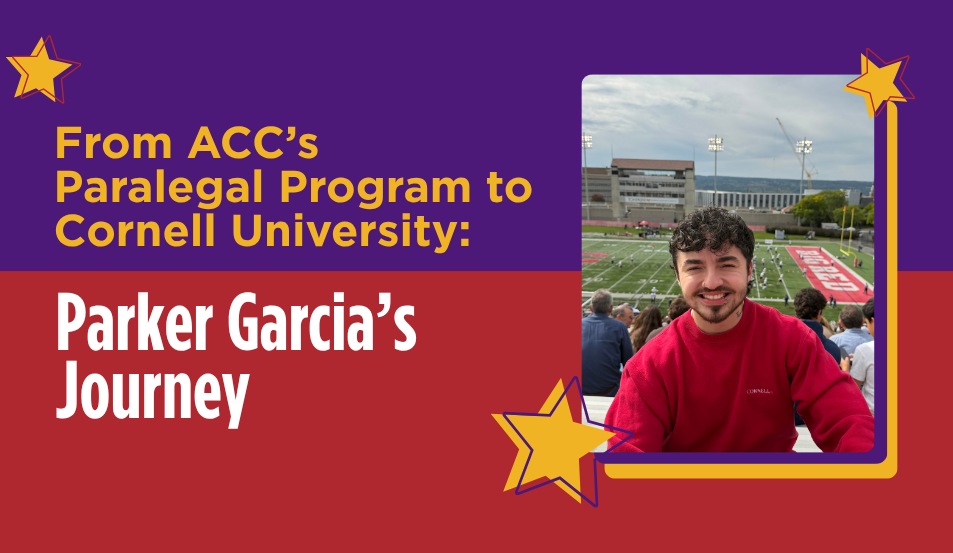
When Parker Garcia returned to college, he knew he wanted to find a path that connected his education with his passion for law and advocacy. At Austin Community College District (ACC), he found that direction through the paralegal program, where he learned from faculty with firsthand knowledge of the legal field, gained hands-on experience through the internship program, and discovered opportunities for how he could use law as a tool for advocacy.
Garcia, who graduated from ACC in 2026, recently began a new chapter at Cornell University after earning admission on a full scholarship. Cornell is also accepting some of Garcia’s ACC paralegal coursework for elective credit, extending the impact of his community college education into his next academic chapter. For Garcia, however, the value of his ACC experience extends beyond the credits that went with him to Cornell.
“Cornell is the next step in building on that foundation, but ACC is really where I discovered the direction I wanted my education and career to take,” said Garcia.
That foundation was built through experiences both inside and outside of the classroom. Garcia’s paralegal program professors brought their professional experience into their teaching, helping students connect what they are learning to the real world. The program further supports student success through an internship program, allowing students to gain real-world experience before graduation.
“Hands-on learning is essential to our program because it bridges the gap between learning about the law and learning how legal work is actually performed,” said Shawn Slack, J.D., ACC’s Paralegal Department Chair. “Our internship program not only strengthens our relationships with employers; it allows the legal community to provide authentic feedback about how our graduating students are doing, which also influences the program’s curriculum.”
One experience that helped shape Garcia’s time at ACC was an internship at the Stop Abuse For Everyone (SAFE) Alliance, an Austin nonprofit that provides services and support to survivors of child abuse, sexual assault and exploitation, and domestic violence. The opportunity, which Garcia credited Slack with helping him secure, gave him the opportunity to connect his classroom learning with real-world experience.
Garcia’s journey also reflects the possibilities available to ACC students who are hoping to continue their education beyond an associate degree. At ACC, he was involved in the Honors Program and served as president of the Honors Student Organization. He was one of only 24 community college students from across the country selected for the 2025 Summer Scholars Program at Chautauqua, an opportunity exclusively open to Honors Program students. He also served as an LGBTQIA+ Constituency Senator in the Student Government Association during the 2024-25 academic year. Now at Cornell, Garcia is continuing his education while carrying forward the knowledge and experiences he gained at ACC.
Read the Q&A below to learn more about Garcia’s ACC experience, his journey to Cornell, and the opportunities that helped lead him to an Ivy League institution.
Q&A With Parker Garcia
What initially drew you to ACC’s Paralegal Program, and what made you decide to pursue paralegal studies?
At the time, I was pursuing an associate degree in government, but I felt like I was not studying what I was truly passionate about, which was law. I wanted to gain a foundation of knowledge about the legal field and better understand what working in law actually looked like. When I discovered that ACC had a Paralegal Program, I looked through the curriculum and immediately knew it was exactly what I was looking for.
What did you enjoy most about your experience in the paralegal program, and how did it shape your academic or career goals?
One of the things I enjoyed most was hearing stories from my professors about their own experiences in the legal field. Many of my professors still worked their “day jobs,” so they were able to take cases and situations they had actually experienced and connect them to what we were learning in class. That made everything feel much more real. I also really enjoyed my internship with SAFE Alliance. Professor Slack made me aware of the opportunity, and I immediately jumped at it because it allowed me to gain legal experience in the nonprofit field, which is exactly the type of work I hope to pursue in the future. That experience helped confirm that I want a career where I can use the law as a tool for advocacy.
You recently transferred to Cornell University on a full scholarship. What was the application and transfer process like, and what did being accepted mean to you?
The process of applying to Cornell was nerve-racking, and then figuring out how to move across the country was even more nerve-racking! But I am extremely grateful for the experiences the Paralegal Program gave me because I wrote a lot in my application about how the program amplified my passion for law and advocacy. I think the admissions committee was able to recognize how those experiences shaped what I wanted to do next. Being accepted into a university like Cornell is a privilege to me. I come from a nontraditional, first-generation background, so I know I need to make this opportunity count. Not everyone from a background like mine gets an opportunity like this, and I try to remember that while I am here.
Looking back on your time at ACC, were there any professors, courses, experiences, or opportunities that had a particularly meaningful impact on your journey?
There were many. Laura Bates, the attorney I interned with and also a professor in the Paralegal Program, gave me so much knowledge and experience in the short time I worked with her. Working with Laura gave me valuable insight into a career that I could see myself pursuing in the future. The Honors Program at ACC also played a huge role in my journey. It challenged me academically and helped prepare me for some of the intense discussions and writing I am now doing at Cornell. My time in Student Government also gave me opportunities to advocate for other students, work with people from different backgrounds, and become more confident using my voice. All of those experiences helped prepare me for where I am now.
Was there a particular moment at ACC when you realized you were capable of pursuing opportunities like Cornell? If so, what happened?
I do not think there was one specific moment. It happened gradually as I became more involved at ACC. When I first returned to college, transferring to a university like Cornell was not something I necessarily saw as realistic for myself. But through the Honors Program, Student Government, the Paralegal Program, and the support of professors who believed in me, I started challenging myself more. Every time I took on something that seemed intimidating and succeeded, I became a little more confident about what I was capable of doing. Eventually, applying to Cornell went from something that seemed impossible to something I felt like I owed it to myself to at least try.
What advice would you give to current ACC students who are considering the paralegal program, transferring to a four-year university, or pursuing an ambitious academic goal?
My biggest advice would be to take advantage of the opportunities around you and do not count yourself out before you even try. ACC has so many resources, programs, professors, and opportunities, but you have to be willing to seek them out. I almost did not apply to Cornell because I thought there was no way I would get accepted. If I had listened to that doubt, I would not be here today. Apply for the internship, join the organization, talk to your professors, apply for the scholarship, and submit the transfer application even if you think it is a long shot. The worst thing that can happen is someone tells you no, but sometimes they might actually say yes.
What are you studying at Cornell, and what are your goals for the future? How does your experience at ACC connect to where you hope to go next?
I am studying Industrial and Labor Relations (ILR) at Cornell University’s ILR School. The program allows me to study areas like labor law, economics, history, workplace relations, and policy, which connects really well with the legal foundation I developed at ACC. My long-term goal is to attend law school and pursue a career where I can work in civil rights and policy. My experience at ACC, especially through the Paralegal Program and my internship with SAFE Alliance, showed me what legal advocacy looks like beyond a textbook. Cornell is the next step in building on that foundation, but ACC is really where I discovered the direction I wanted my education and career to take.
Anything else you’d like to add?
I think community college students sometimes underestimate how far their education can take them. ACC gave me opportunities that completely changed the direction of my life. I went from returning to college without being completely sure where it would lead me to studying at Cornell and preparing for law school. I am incredibly grateful for the professors, staff, and programs at ACC that invested in me along the way, and I hope other ACC students realize that where you start does not determine how far you can go.
Learn more about ACC’s Paralegal Program here.