
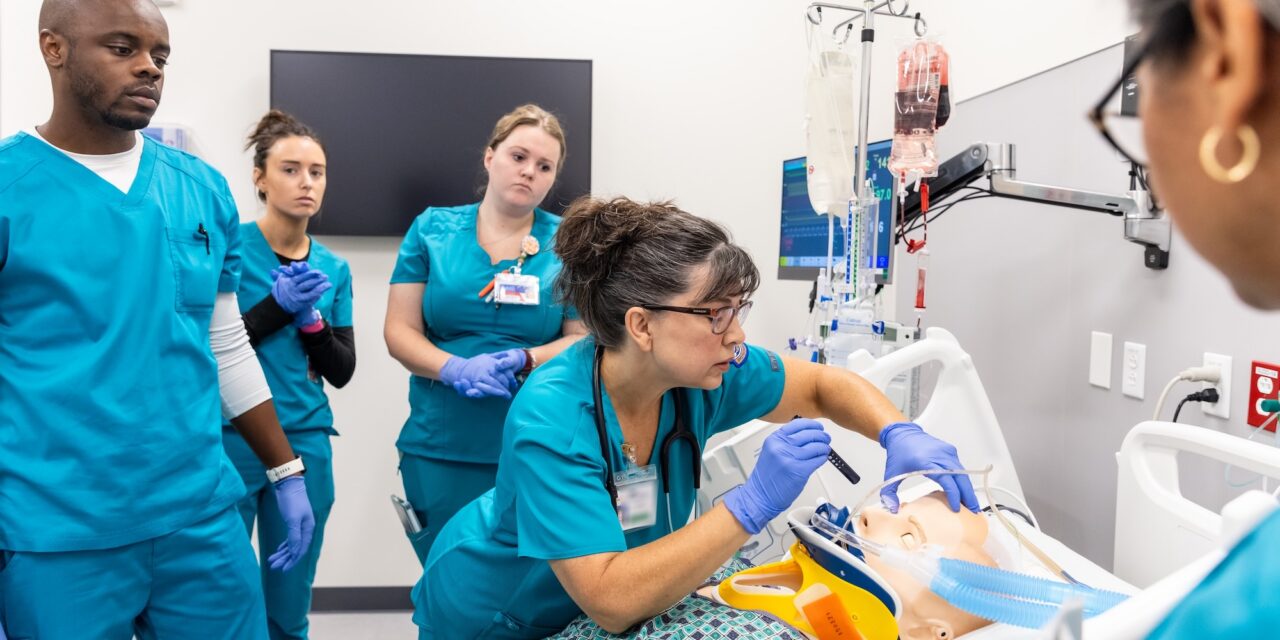
As Austin Community College (ACC) continues its transition to a “School of” structure, the Division of Healthcare Professions, formerly Health Sciences, is now organized around Schools whose names more clearly reflect the areas of healthcare education they support. The School of Health Sciences and the School of Nursing offer programs that prepare students for a variety of healthcare careers, combining classroom instruction with hands-on learning and clinical experiences. Together, the Schools provide students with opportunities to develop the knowledge and skills needed for professional practice.
The new structure brings greater clarity to how healthcare programs are organized at ACC, making it easier for students to see where their interests can lead. While the names may be new, the programs, courses, and opportunities students rely on remain the same.
This article is part of an ongoing series highlighting ACC’s Academic Affairs Schools following the College’s transition to its “School of” structure. View the previous feature on the School of College Readiness and the School of Community Education here.
School of Health Sciences
The School of Health Sciences brings together programs that meet the region’s demand for healthcare professionals across a range of specialized fields. For students, that breadth creates multiple entry points into a growing and evolving healthcare workforce.
“The School of Health Sciences offers diverse pathways across clinical, diagnostic, emergency, and non-clinical fields, reflecting the wide array of high-demand careers in modern healthcare,” said Estrella Barrera, dean of the School of Health Sciences.
Recent Milestones and Successes
The School’s expanding reach is reflected in its strong program outcomes and new partnerships designed to introduce more students to healthcare careers.
- Central Texas Healthcare Academy: Launched this fall, the Healthcare Academy brings together industry and community partners and independent school districts to introduce students to healthcare careers as early as ninth grade.
- Growing completions: Health Sciences completions increased 44% from 1,243 in AY2021 to 1,786 in AY2025 across all degree and award types.
- Program outcomes: The 2026 Dental Hygiene cohort achieved 100% on-time completion and first-attempt board pass rates.
Building a strong healthcare workforce starts with creating connections early. The School connects students with the people and opportunities that can help turn an interest in healthcare into a career.
“Partnerships with regional healthcare systems, schools, and community organizations—including our new Healthcare Academy—extend our impact from early career exploration through employment,” said Dr. Nina Almasy, associate vice chancellor for the Division of Healthcare Professions.
“We want students to have the opportunity to explore healthcare careers, connect with healthcare professionals, and begin developing a sense of belonging in healthcare before they ever have to choose a career path,” said Barrera. “It’s really about opening their eyes to the incredible range of opportunities in healthcare and helping them see, ‘I can do this. I belong here.’”
What’s Next
The School is focused on ensuring students have the skills and adaptability to navigate an increasingly technology-enabled healthcare field.
“As healthcare technology advances, our priority is ensuring students master both modern technical systems, like digital diagnostics and electronic medical record management, and the critical clinical judgment, adaptability, and patient-centered communication essential for the future workforce,” said Barrera.
School of Nursing
The School of Nursing encompasses ACC’s nursing programs, supporting students at different stages of their education as they pursue one of the healthcare field’s most essential professions.
“What distinguishes ACC’s nursing programs is our commitment to access, excellence, and student success,” said Dr. Tiffany Ricks, dean of the School of Nursing. “We serve students from many different backgrounds and at many different stages of life, and we work hard to create pathways that make nursing education attainable and affordable without compromising rigor or quality.”
Recent Milestones and Successes
The School’s recent accomplishments reflect both the quality of its programs and its focus on the nursing workforce.
- Licensure outcomes: ACC’s 2025 Associate Degree Nursing graduates achieved a 95.17% NCLEX-RN pass rate, while 2025 Vocational Nursing graduates achieved a 98.53% NCLEX-PN pass rate.
- Nursing innovation: ACC recently received a Nursing Innovation Grant Program award from the Texas Higher Education Coordinating Board, creating opportunities to expand innovative approaches to clinical education and support the nursing workforce pipeline.
Almasy said the School’s accomplishments underscore a broader commitment to expanding access to healthcare careers and strengthening the region’s healthcare workforce.
“As a regional leader in healthcare workforce development, Healthcare Professions creates accessible pathways to meaningful careers while preparing the skilled, compassionate professionals our communities urgently need,” Almasy said.
What’s Next
The School of Nursing will continue advancing its work while responding to the changing needs of students, healthcare partners, and the nursing workforce.
“The goal is thoughtful, sustainable innovation that protects quality, strengthens the student experience, and prepares safe, competent, compassionate nurses for the future of healthcare in Central Texas and beyond,” said Ricks.
Looking Ahead
The transition to ACC’s “School of” structure makes it easier to see the distinct but connected opportunities available through the School of Health Sciences and School of Nursing. As ACC moves forward, Healthcare Professions will continue opening doors for students to explore healthcare careers, build their skills, and prepare for what comes next.
“Together, we are developing exceptional talent, improving patient care, and building a stronger, healthier Central Texas,” said Almasy.
For more information about the “School of” structure, including frequently asked questions and the implementation timeline, visit the Transition to a “School of” Structure webpage.