
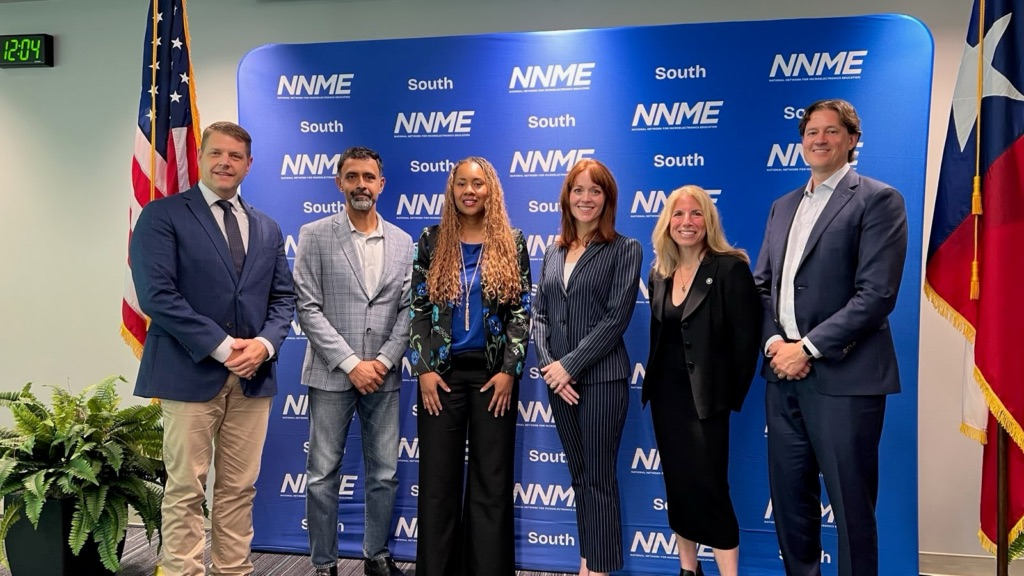
College joins UT-Austin, Texas A&M, Georgia Institute of Technology, and others to scale workforce pathways across the South
Austin Community College District’s (ACC) nationally recognized semiconductor workforce programs will play a key role in a new 10-state semiconductor alliance announced June 9 at the University of Texas at Austin. ACC was selected for its advanced, scalable training model, which will help prepare more students for careers in the semiconductor industry.
The new National Network for Microelectronics Education (NNME) South Node is one of the nation’s first regional hubs of its kind, designed to establish a national strategy to expand the semiconductor workforce.
“This work reflects what ACC does best. We listen to industry, work alongside our partners, and build pathways that help students be ready for what’s next,” says ACC Chancellor Dr. Russell Lowery-Hart. “The semiconductor industry is changing rapidly, and our responsibility is to make sure students and employers aren’t trying to keep up alone. When education and industry come together around a shared goal, we can move faster, respond to workforce needs in real time, and create opportunities that change lives.”
The launch comes as the semiconductor industry faces growing workforce demands nationwide. Industry projections estimate the United States could face a shortage of more than 100,000 semiconductor workers by the end of the decade as domestic manufacturing capacity continues to expand. The alliance was created to help address that challenge by connecting universities, community colleges, employers, and workforce organizations across the South.
“No single institution can meet the semiconductor workforce demand alone. This alliance brings together universities, community colleges, employers, and workforce partners to build talent at the scale the industry requires. ACC is proud to lead that effort — creating stronger connections and gluing our work together to build a workforce ecosystem that’s ready for what’s next and supports growth across the region,” says Garrett Groves, ACC vice chancellor of Strategic Initiatives.
ACC was selected for two distinct roles:
- Expanding its U-STARS semiconductor training program to serve university engineering and STEM students across the region.
- Serving as the inaugural lead for the alliance’s earn-and-learn workforce development efforts.
The selection builds on ACC’s growing national reputation in semiconductor workforce development. The College’s STARS (Semiconductor Technician Advanced Rapid Start) curriculum has been published as an open educational resource and is being adopted by institutions and employers seeking to expand semiconductor training capacity. The U-STARS program is an adaptation created specifically by ACC to provide university bachelor’s degree students with direct technical experience and knowledge that is not available in traditional university courses.
Expanding ACC’s Semiconductor Training for University Students
Through its U-STARS program, created in partnership with the Texas Institute for Electronics (TIE) at The University of Texas at Austin, ACC provides hands-on semiconductor technician training that complements traditional engineering and STEM education. The program gives students practical experience working with the equipment, processes, and technologies used in advanced semiconductor manufacturing.
Students from The University of Texas at Austin were the first participants in the program in May 2025, with four additional cohorts returning in 2026. This summer, engineering students from Texas A&M University will participate in training at ACC’s Round Rock Campus.
“What makes ACC’s semiconductor training model successful is that students learn by doing. We built curriculum designed for the future. We combine classroom instruction with hands-on experience where students use the tools, equipment, and processes they’ll encounter in the industry,” says Dr. Laura Marmolejo, ACC associate dean of Advanced Manufacturing. “Through this alliance, we’re excited to expand our program and bring it to more university students.”
Through the alliance, ACC will receive support to expand U-STARS to additional university partners across the region.
Leading Earn-and-Learn Workforce Pathways
ACC will also serve as the inaugural lead for the alliance’s earn-and-learn workstream, helping coordinate efforts to expand customized training, employer-connected learning opportunities, and apprenticeship pathways across the 10-state region.
Working alongside alliance partners, ACC will help identify opportunities to scale workforce models that connect students directly to industry needs while supporting employers facing growing talent demands.
About the Alliance
Led by the Texas Institute for Electronics, the Alliance was established through the National Network for Microelectronics Education (NNME), a national effort supported by the National Science Foundation and SEMI Foundation to strengthen America’s semiconductor workforce pipeline.
“We are building a workforce that is not only skilled but adaptable, one that can grow with the demands of the industry and create real economic opportunity across the region,” says Alyssa Reinhart, director of workforce development at TIE and the NNME South Node Lead. “That is what this coalition has been working toward and what the NNME South will deliver.”
The alliance is one of the first four regional networks established through the National Science Foundation-supported initiative and is eligible for up to $20 million over five years. The South Node expands across Utah, New Mexico, Texas, Oklahoma, Arkansas, Louisiana, Mississippi, Alabama, Georgia, and Florida.
Other partners in the Alliance include 32 industry employers and 35 academic institutions, such as:
- AMD
- Arm
- Cadence
- NXP Semiconductor
- Samsung Austin Semiconductor
- Synopsys
- Texas Instruments
- The Texas A&M Semiconductor Institute
- The University of Florida and Florida Semiconductor Institute
- Georgia Institute of Technology
- The University of Louisiana at Lafayette
- University of Oklahoma
- University of Arkansas
A list of all industry and academic partners can be found on the NNME South website.