
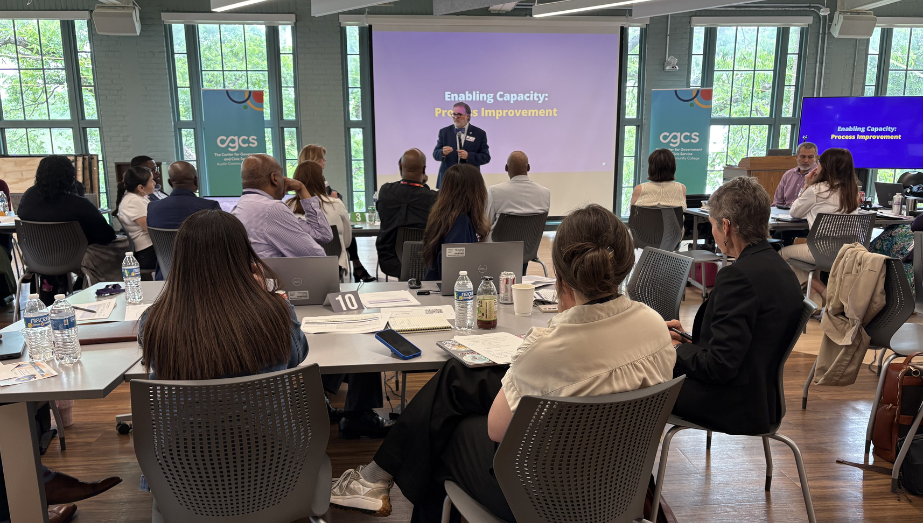
On April 23, leaders from across the College gathered for the Institutional Effectiveness (IE) Report Card Convening. The workshop marked an important milestone in moving the IE Report Card from planning to activation and execution.
At the convening, attendees were introduced to the final IE Report Card metrics that will serve as the College’s priorities over the next 12 to 18 months. These priorities align with ACC’s North Star Goal, Theory of Change, and ongoing work to improve student success, operational excellence, and institutional effectiveness.
“The convening was an important next step in moving the IE Report Card from planning into action,” says Chancellor Dr. Russell Lowery-Hart. “What stood out most is how our teams showed up. Their willingness as leaders across the College to engage honestly, ask thoughtful questions, and start connecting their work to the goals and actions that will move us forward. This next phase is about focus and execution. It’s not about adding more work. It’s about being intentional with the work we’re already doing and making sure it’s driving real progress for our students and our College.”
Throughout the day, attendees engaged in discussions designed to align ongoing and planned work with the goals that matter most for student success and institutional improvement.
Institutional Effectiveness Metrics
The IE Report Card includes nine institutional effectiveness metrics. Under each metric are goals and actions aligned with other College initiatives, such as the Theory of Change.
| Institutional Effectiveness Metric | Baseline | Target |
|---|---|---|
| Completion of degrees and awards (credentials of value) | 11,604 (Total) 9,327* (HB 8) | 20% – 13,925 (Total) 11,192* (HB8) |
| Time and semester credit hours (SCH) to associate degree completion | 4.4 years 81 SCH | 3.8 years 77 SCH |
| Percent of first-time-in-college students who graduate, complete, or transfer within 3 years | 47% | 70% |
| Fill rate of core course classes overall (and by campus) | 88% | 85% |
| “Access to Technology” and “Student Digital Experience“ combined measure | TBD* | TBD* |
| “I seldom get the ‘runaround’ when seeking information on this campus.” | 69% | 81% |
| Cost per contact hour | $28.73 | $25.00 |
| Percent of employees completing annual training or professional development | 51% | 95% |
| “Working with colleagues across divisions (e.g., across vice chancellor areas) outside of my department is collaborative and productive.” | TBD Fall 2026 (employee climate survey) | TBD* |
Moving to Execution
Goal activation and execution is a four-step process that will take 12 months, culminating in May 2027.
- Step 1. Initial Meeting with Goal Leads | May 15 – June 19
- Step 2. Activation Meetings | June 15 – July 31
- Step 3. Budget Alignment | June 15 – July 31
- Step 4. Launch & Review | By September 1
What Happens Next?
The immediate next step over the coming weeks is the official confirmation of leads for each of the goals.
Once finalized, goal leads will begin working with their core teams and collaborators to move approved goals into the development stage with the support of the IE Team and Enterprise Project Management Office (EPMO). This activation phase will involve:
- Translating lead actions into a small set of key milestones
- Identifying core team members, clarifying roles, and establishing a meeting cadence
- Identifying resource needs
- Setting up tracking, reporting, and support structures
To ensure teams have the resources they need, the IE Team and EPMO will offer workshops throughout May and June. These workshops will cover minimum execution standards, project management tools, and progress-tracking templates for all confirmed goal leads.
Stay Engaged
Organizers encourage all employees to stay engaged as this work progresses, particularly those who may serve as collaborators on specific goals or lead actions. More specific next steps will be communicated once goal leads are formally announced.
In the meantime, the College community is invited to review the Workshop Slide Deck to learn more about the transition to the activation phase.
And stay tuned to the FacStaff InfoHub throughout the summer, as we will dive deeper into the metrics and the goals.
For any questions about the IE Report Card or upcoming workshops, please contact the IE Team at [email protected].