
At Austin Community College District (ACC), our mission centers on empowering students to reach their fullest potential—wherever their goals may lead. About a third of ACC students transfer to a four-year university each year, and a growing number are being admitted to Ivy League schools.
Recently, our community celebrated an encouraging milestone: at least six Honors students earned admission to some of the nation’s most prestigious institutions, including Yale, Cornell, Brown, Columbia, and Stanford.
“While our peer institutions typically see 1 to 3 students gain admission to Ivy League universities annually, ACC had a record-breaking cohort of transfer students. Our remarkable success caught national attention,” said Honors Program Associate Dean Dr. Anne-Marie Thomas, referring to The Edu Ledger article published on August 4, 2026.
A major catalyst behind these extraordinary outcomes is the collaborative guidance of the College’s Transfer Services Department, Honors Program, and faculty and staff, including Honors Math Professor Conrad Miller.
While these accomplishments highlight the extraordinary talent of our students, they also reflect a broader institutional effort to cultivate learning environments where all scholars thrive.
ACC’s Fall Transfer Week showcases the support and opportunities for students who are considering transferring to a four-year university. Students are invited to a special session on September 14, “High-Impact Opportunities for Transfer Students.” The event will showcase key national programs—including ACC’s invitation to the Transfer Scholars Network (TSN), the Jack Kent Cooke Transfer Scholarship, and the Goldwater Scholarship.
Read our Q&A below with Miller to learn more about his approach and how ACC is paving the way to top-tier universities.
What do you think sets ACC apart to help prepare students for that level of academic rigor?
ACC’s mission as a community college is to serve the entirety of the local community. We need to remind ourselves that our local community has students who are as capable as the students who attend a selective university in the Ivy League, or who attend a top research university such as The University of Texas.
Multiple students have credited your classes and recommendation letters as key factors in their transfer to Ivy League universities. How do you help prepare students?
Many ambitious students come to ACC since ACC is affordable, and many of these students end up in our Honors Program. When these students walk into my Honors Calculus class on the first day, they already desire a deeper understanding of what I am there to teach than many other teachers might give them credit for. What I need to do in return is to trust that they are capable.
Many generations of students have left their mark on my Honors Calculus classes. Each time a student pushes me to explain a detail that I would typically ignore, or to provide an explanation of how we know that something is true, I do my best to help the student understand more deeply, and that new level of understanding becomes incorporated into my future classes making my own classes more rigorous.
I will say as an example that one student, Claire Hobbs, contributed what I now jokingly refer to as the ‘Yale integral.’ It was a hard integral that appeared on one of Claire’s tests at Yale. I show my Calculus 2 students that if they stick it out, I have taught them everything they need to complete this problem. I want my students to know they are fully capable of doing hard problems if they just trust themselves enough to keep moving forward.
What motivates you to go the extra mile for students aiming for top-tier transfer institutions?
I don’t do what I do for those students in particular. Whether or not a student is aiming to attend an Ivy League institution or a top research institution plays no part in how I think about my classes.
My own education began at a liberal arts university. I cannot overstate how much the education I received at that institution affects my thinking about how education should be done. What I learned is that knowledge is interconnected, and our understanding is enriched when we see the connections between different disciplines. Understanding a discipline means understanding what that discipline accepts as knowledge, and what we accept as knowledge hinges on the type(s) of justification we accept.
In mathematics, justification is based on the idea of proof, while in science justification is based on empirical evidence. My ‘extra mile’ is doing what I can to give this same educational experience to my students. The Honors Program helps me in this mission by providing the right environment since I alone cannot make this happen for my students.
You were recently named ACC’s college representative for the prestigious Goldwater Scholarship. What does this opportunity mean for ACC students?
The Barry Goldwater Scholarship is for undergraduate students who show promise as future researchers in science, engineering, and mathematics. The scholarship earned its prestige by selecting those students who have already accomplished something of worth in their chosen discipline.
I want ACC students to understand that this does not mean that the student needs to have accomplished something groundbreaking. Most scientists and mathematicians work on problems that add incrementally to our knowledge rather than on groundbreaking research. When a student receives the Barry Goldwater Scholarship, it demonstrates that the student is already capable of doing the type of incremental work required to advance our scientific knowledge.
What earning the scholarship would mean for a student is that it clearly communicates to any future graduate programs that they apply to that they are fully capable, and have the drive to be successful.
Writing powerful recommendation letters is a key part of the transfer process. What advice would you offer to fellow faculty on writing letters that truly stand out to selective admissions committees?
The advice I would give for both students and other faculty is to ensure that the letter tells the admissions office something they would not already know from reading the other documents submitted by the student as part of their application. The advice is obvious, but it takes some effort to make each letter different. For professors, this means finding something positive to say about the student beyond just saying that they came to class consistently and made a good grade. The admissions office will already know the student’s grades.
It does not need to be complicated. As an example, for one of the students who transferred to Yale, I mentioned that the student asked a particularly clever question in class that related two subjects we already studied, and this same student added something extra to a project that connected what they learned in my Calculus class with something that they learned in Professor Ricardo Mastroleo’s Honors Engineering University Physics class. This student demonstrated that they were capable of making connections that were not explicitly stated. This last connection was interesting enough that I incorporated it as a standard part of the project.
For students, my advice means that they should seek out their professor during office hours and make a personal connection. Let the professor know what they are interested in beyond the class, and how the class fits into their future plans. This will give the professor something to say in their letter of recommendation.
How can instructors and staff across ACC better identify, encourage, and mentor high-achieving or ambitious scholars early in their academic journey?
My students are the ones who make me a successful teacher. ACC has the core values: courage, compassion, joy, and yes. The last value in this list has been my quickest route to success. Most of the things I have done for my ambitious students — honors or otherwise — come from saying ‘yes’ whenever I believe I can help.
As I said previously, the Barry Goldwater Scholarship is for undergraduate students who show promise as future researchers in science, engineering, and mathematics. I am ACC’s campus representative for this scholarship because my honors student, David De Leon, brought it to the attention of the Honors Program and the Dean of Science, Engineering, and Math that we did not have a campus representative. I said ‘yes’ when asked if I could help. Now I am involved in a collegewide committee to bring research opportunities to ACC for our students. This involvement began with me saying ‘yes’ to becoming the Goldwater Scholarship campus representative.
I am currently a faculty mentor to the student Mathematics Club because another honors student, Jeffrey Moast, wanted to start the club. He asked if I would be a faculty mentor, and I said ‘yes.’ But Jeffrey did the great majority of the work to make it happen. Connected with the Math Club, Jeffrey and a couple of my colleagues in the Math Department, Professors Jordan Barry and Josiah Bansueda Banks, did the work to host the American Statistical Association’s annual DataFest competition at ACC. Any credit I received for helping to bring this event to ACC really goes to those individuals. I just helped bring everyone together.
Each time I say ‘yes,’ what I receive in return is greater than the help I provide. This allows me to become a more helpful teacher to future generations of students.
You’re participating in the upcoming September 14th event on high-impact opportunities. How do events like this—and initiatives like the Transfer Scholars Network—help build a supportive culture for ambitious transfer students at ACC?
The Honors Program, and Dean Anne-Marie Thomas in particular, do so much to advertise high-impact opportunities that many students would not know about otherwise. The more students understand their options, the better prepared they are to take advantage of those opportunities.
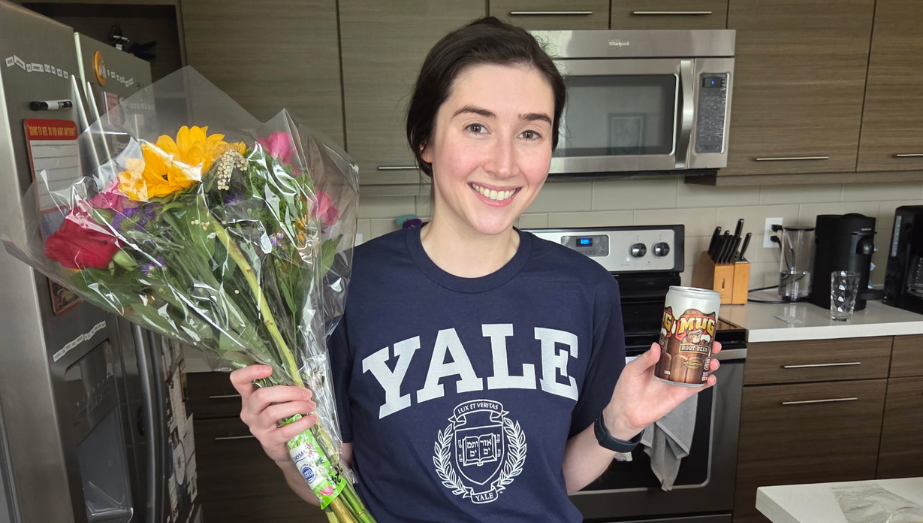
Once a single ACC student grabs onto an opportunity, like Claire Hobbs going to Yale, it makes it easier for the next student to see that same possibility as an option for themselves. Our students need to know what is possible, so that they will see themselves capable of accomplishing more than what they might have initially dreamed. My former student Sarah Hutcher (in photo above) did not think she was capable of getting into Yale until we told her that this was a possibility. Now she attends Yale along with several other former ACC students.
Anything else you’d like to add?
I think there is an assumption that any discussion of honors classes, transfers to the Ivy League, or prestigious scholarships is automatically elitist. I want to push back on this idea. If we have students who benefit from the type of classes and opportunities that the Honors Program provides, isn’t it in their interest that we do our best to help? This does not diminish the accomplishments of students who take advantage of other programs offered by ACC.
Because ACC is a community college, we should be willing to help members of our community to accomplish their goals, whatever those goals might be.